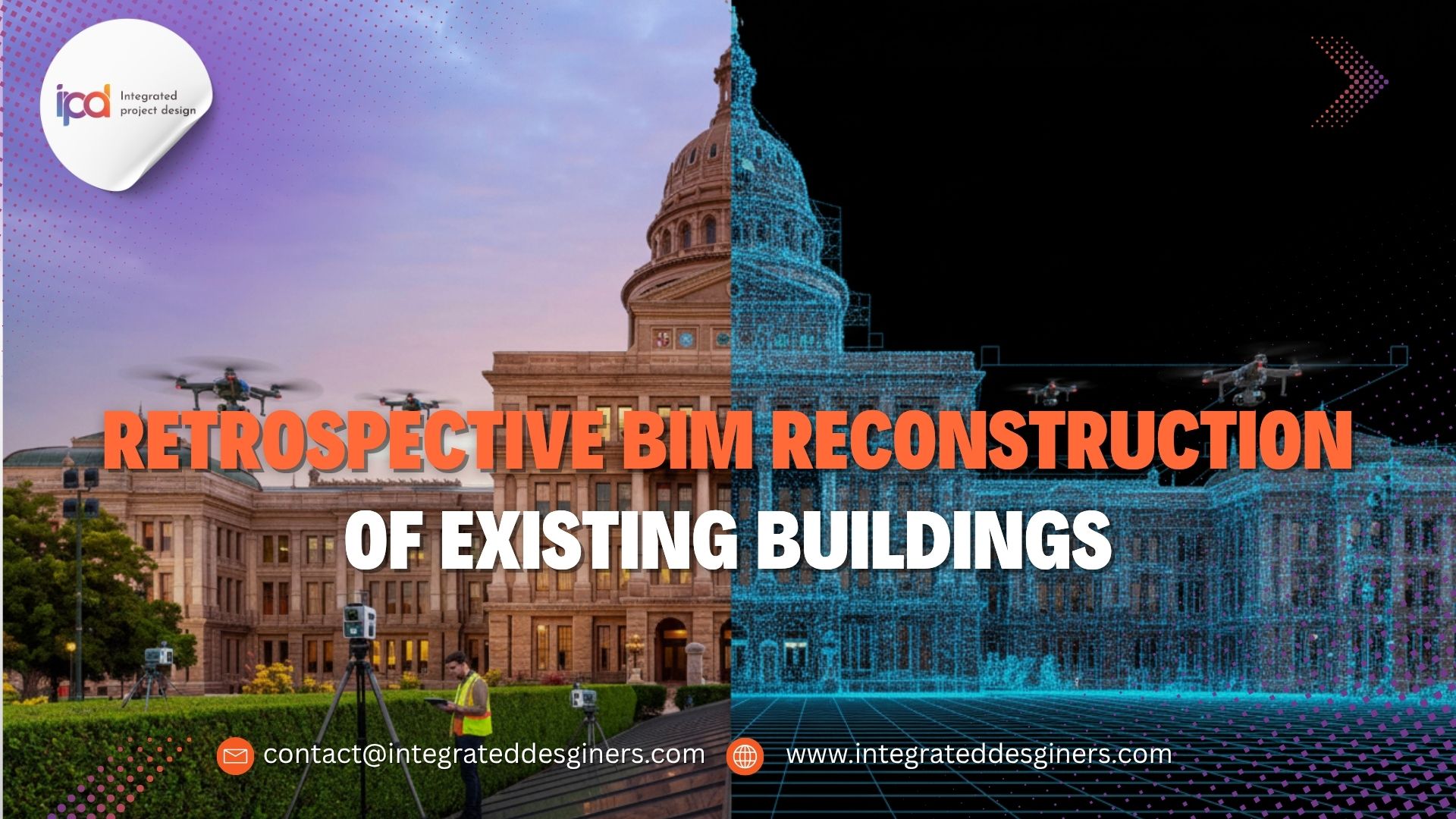
Retrospective BIM Reconstruction of Existing Buildings plays a vital role in transforming physical structures into intelligent digital twins. It enables architects, engineers, and facility managers to capture as-built data with high accuracy and bring outdated or undocumented spaces into digital workflows. In Austin, where historic charm meets modern growth, retrospective BIM reconstruction ensures seamless renovation, sustainability, and asset management.
Understanding Retrospective BIM Reconstruction of Existing Buildings
Traditional BIM workflows begin during design, while Retrospective BIM Reconstruction of Existing Buildings starts after completion—recreating models from reality. This reverse engineering approach captures geometry, topology, and semantics from 3D scans, point clouds, or manual surveys, producing a highly accurate, data-driven BIM environment.
From Point Clouds to Intelligent Models
Using LiDAR, photogrammetry, or drones, teams capture millions of data points to generate dense point clouds. These datasets are processed with software like Autodesk ReCap or Leica Cyclone, then transferred to Revit or ArchiCAD, where parametric objects—walls, columns, HVAC ducts—are reconstructed based on as-built conditions.
Why Retrospective BIM Reconstruction Matters in Austin
Austin’s evolving architectural landscape—balancing heritage and innovation—makes Retrospective BIM Reconstruction of Existing Buildings indispensable.
-
Historic preservation: Digitally archive heritage sites and façades.
-
Renovation and retrofitting: Modernize older assets while maintaining authenticity.
-
Facility management: Improve asset lifecycle and maintenance planning.
-
Sustainability: Enable energy modeling and embodied-carbon tracking aligned with Austin’s green building codes.
Technical Workflow for Retrospective BIM Reconstruction
1. Data Capture
High-precision 3D scanning collects external and internal geometry through LiDAR or drones.
2. Data Processing
Point clouds are aligned, cleaned, and registered into unified coordinate systems to eliminate distortion.
3. BIM Modeling
Architectural, structural, and MEP components are recreated within Revit, Rhino, or ArchiCAD. Dynamo and Grasshopper automate rule-based modeling and tagging.
4. Semantic Structuring
Metadata such as materials, maintenance history, and manufacturer details are embedded—enriching models beyond geometry.
5. Validation & Quality Control
Deviation analysis and clash detection ensure accuracy and reliability before project delivery.
Integrating Retrospective BIM Reconstruction with Facility Lifecycle Management
Once models are created, Retrospective BIM Reconstruction of Existing Buildings supports the complete lifecycle—from operations to renovations. By integrating with CMMS and IoT systems, facility owners gain actionable intelligence through digital twins.
-
Predictive maintenance and repair tracking.
-
Real-time space utilization and asset monitoring.
-
Energy performance optimization using BIM-to-BEM links.
-
Long-term compliance reporting aligned with Austin’s sustainability goals.
Tools Empowering Retrospective BIM Reconstruction
-
Hardware: Leica BLK360, Faro Focus3D, Trimble X7, DJI drones.
-
Software: Autodesk ReCap, Revit, Navisworks, Rhino, Grasshopper, Dynamo.
-
AI & Automation: Machine learning enhances component classification from point clouds.
-
Cloud Collaboration: Autodesk Construction Cloud and Trimble Connect enable version control and secure access.
Automation scripts accelerate data tagging and improve repeatability—reducing manual rework and enhancing consistency across projects.
Commercial Benefits of Retrospective BIM Reconstruction
-
Reduced survey and modeling time.
-
Accurate as-built documentation for renovation.
-
Improved coordination and transparency.
-
Enhanced sustainability and compliance.
-
Increased client trust and stakeholder engagement.
In regions like the USA, UK, UAE, and India, firms leveraging retrospective BIM workflows outperform traditional survey methods in precision, delivery time, and sustainability metrics.
Global Insights & Regional Applications
USA
Cities like Austin and Boston adopt scan-to-BIM for renovation and infrastructure modernization.
UK
Government BIM Level 2 mandates drive digitization for heritage estate management.
UAE
Scan-to-BIM supports modernization while preserving cultural heritage.
India
BIM reconstruction accelerates smart-city and public infrastructure upgrades.
Performing Retrospective BIM Reconstruction
-
Conduct high-resolution scanning via LiDAR or drone.
-
Clean and align point clouds using software like ReCap or Cyclone.
-
Import data into BIM tools and reconstruct geometry.
-
Embed semantic data for materials and maintenance.
-
Validate accuracy and generate digital twin deliverables.

Future Trends — AI, Automation, and Digital Twins
The next phase of Retrospective BIM Reconstruction of Existing Buildings integrates AI-driven recognition and predictive maintenance. Machine learning identifies materials, automates modeling, and enhances energy-performance forecasting. As Austin embraces smart infrastructure, combining BIM with IoT-enabled digital twins will unlock real-time insights into performance, energy use, and asset longevity.
Conclusion
Retrospective BIM Reconstruction of Existing Buildings in Austin is redefining how cities preserve heritage, modernize assets, and achieve sustainability. It bridges physical and digital realms through precise scanning, data-rich modeling, and lifecycle intelligence.
Empower your projects with digital accuracy—embrace Retrospective BIM Reconstruction to future-proof your assets today.