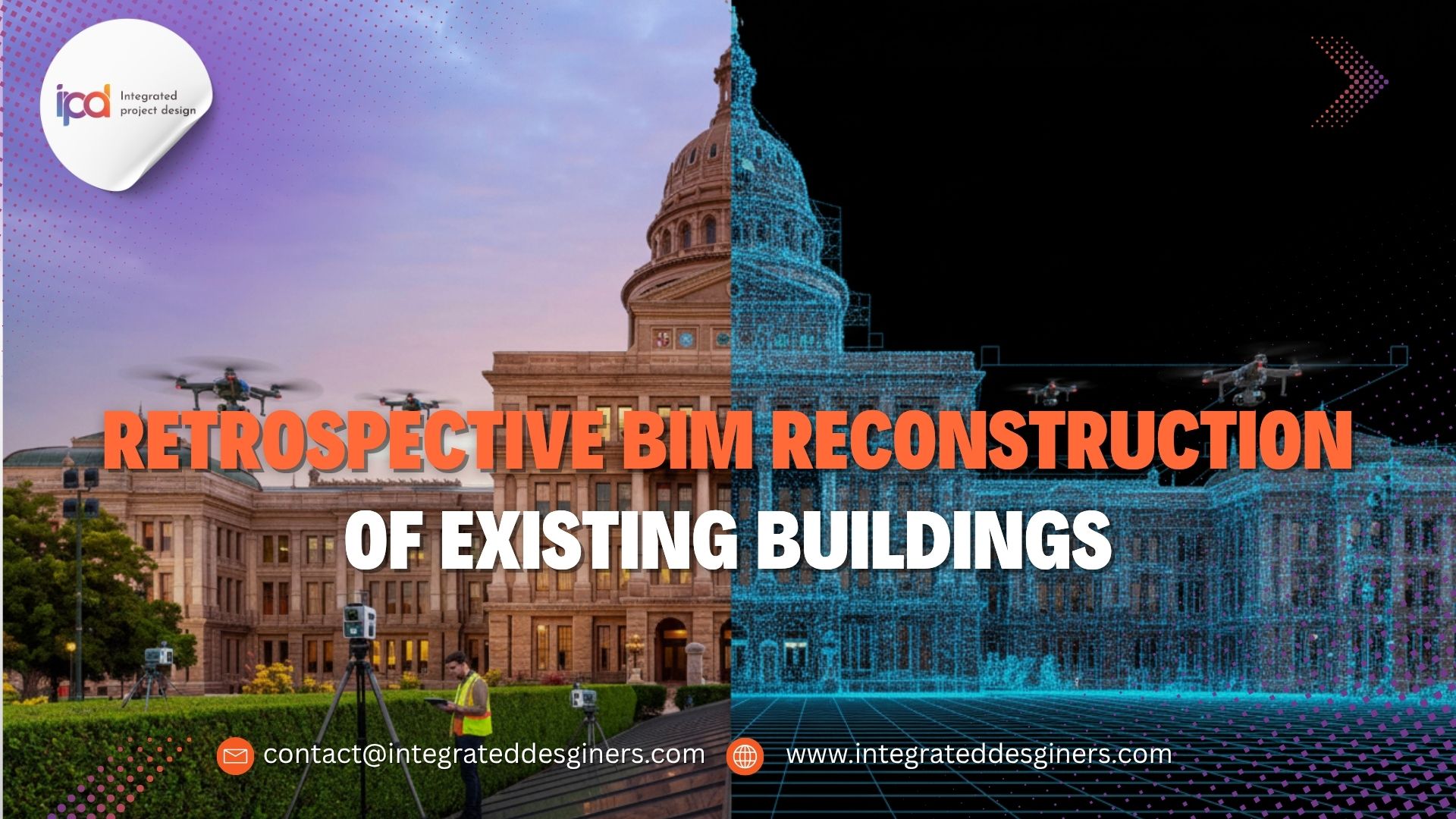
AI-driven Scan-to-BIM automation using deep learning is transforming how the construction and architecture industries adopt Building Information Modeling (BIM). Traditionally, creating BIM models from existing structures—especially using point clouds generated by laser scans—has been labor-intensive and prone to errors. With deep learning, this process is now faster, more accurate, and far less dependent on manual intervention.
Enter AI-powered Scan-to-BIM automation.
This edition of our blog explores how deep learning, a subset of artificial intelligence (AI), is streamlining one of the most time-consuming phases in the digital transformation of buildings: the conversion of raw point cloud data into intelligent, object-based BIM models. We’ll dive deep into the technical mechanisms, highlight key research insights, explore real-world use cases, and outline where the future is headed.
AI-driven Scan-to-BIM automation using deep learning: Transforming the Workflow
Let’s begin with a quick breakdown of the traditional Scan-to-BIM pipeline:
- Data Acquisition: 3D laser scanners or photogrammetry tools capture the spatial geometry of physical environments.
- Point Cloud Generation: These devices produce dense point clouds, consisting of millions (or billions) of 3D coordinates.
- Manual Modeling: Experts manually interpret this data and reconstruct architectural or MEP elements within software like Revit or ArchiCAD.
- BIM Output: The result is a semantically rich model, but the process is often time-consuming, labor-intensive, and costly.
This manual approach introduces inefficiencies and is not scalable for large portfolios of existing buildings.
How AI-driven Scan-to-BIM automation using deep learning is solving inefficiencies
Deep learning has proven its strength in interpreting unstructured data like images, sound, and now—point clouds.
What is Deep Learning in this Context?
Deep learning refers to multi-layer neural networks that learn patterns in complex data. In Scan-to-BIM automation, the objective is to train models to recognize architectural elements like walls, floors, windows, pipes, and columns directly from point clouds.
The breakthrough lies in semantic segmentation—assigning a class label to each point in the cloud (e.g., “wall”, “ceiling”, “pipe”, “beam”). This classification enables intelligent reconstruction into BIM components with minimal human intervention.
What studies reveal about AI-driven Scan-to-BIM automation using deep learning
Recent academic and industry studies validate the power of deep learning in this domain:
- Stanford’s 3D Semantic Parsing project showed that 3D U-Net and PointNet++ architectures achieved up to 88% accuracy in semantic segmentation of indoor environments.
- The Scan2BIM-Net model proposed by researchers from ETH Zurich and TU Munich uses a hybrid CNN-transformer architecture to identify and reconstruct walls, doors, and windows with high fidelity.
- Autodesk and Nvidia have both released internal white papers demonstrating the use of deep learning to automate segmentation and classification of mechanical and structural elements from LiDAR scans.

The results are clear: deep learning models, when trained on sufficient data, are outperforming traditional rule-based and heuristic algorithms in terms of speed, accuracy, and scalability.
Applications of AI-driven Scan-to-BIM automation using deep learning in real projects
Here’s how this technology is currently being applied:
- Heritage and Brownfield Documentation
- AI-driven automation allows preservationists to quickly digitize centuries-old buildings and monuments by auto-generating BIM from scan data. This is especially useful when manual modeling is either risky or unfeasible due to damage or complexity.
- MEP Retrofitting and Maintenance
- For existing facilities with legacy mechanical systems, AI-assisted segmentation helps teams isolate MEP components (e.g., ducts, pipes, conduit) for renovation and clash detection without redrawing manually.
- Facility Management and Digital Twins
- AI-powered BIM generation speeds up the development of digital twins. Accurate, current models help with space planning, energy optimization, and predictive maintenance.
- Construction Verification
- By scanning a construction site and running it through a trained deep learning model, stakeholders can compare as-built vs. as-designed models in real-time, detecting deviations early and reducing rework.
Tech stack behind AI-driven Scan-to-BIM automation using deep learning
Let’s explore the typical AI pipeline in Scan-to-BIM automation:
1: Data Preparation
- Input: Raw point cloud (from LiDAR, photogrammetry, or mobile scanning).
- Preprocessing: Noise filtering, voxelization, or conversion to mesh representation.
2: Semantic Segmentation
- Deep learning models such as PointNet, KPConv, MinkowskiNet, or newer transformer-based architectures like Point-BERT are used.
- Each point is tagged with a semantic label.
3: Instance Segmentation & Classification
- Clustered points are grouped into discrete objects (e.g., a specific beam or window).
- Geometrical fitting and topological constraints are applied to model object shapes accurately.
4: BIM Reconstruction
- Segmented elements are translated into BIM objects using APIs like Revit API, IFC standard exports, or tools like Dynamo.
- Metadata (e.g., dimensions, materials, IDs) is attached automatically.

Challenges facing AI-driven Scan-to-BIM automation using deep learning
Despite its promise, AI-driven Scan-to-BIM is not without challenges:
- Data Diversity
- No two scans are alike. Variation in resolution, occlusions, and environment types (residential vs. industrial) requires domain adaptation and extensive data augmentation.
- Complex Object Detection
- AI still struggles with intricate architectural details or heavily occluded regions. Combining 2D photos and depth data (RGB-D fusion) can improve performance but adds complexity.
- Data Scarcity
- High-quality labeled point cloud datasets for training are still limited. Creating synthetic data using procedural generation or simulated environments is one way around this.
- Interoperability
- AI-generated BIM components must align with IFC standards and native formats (e.g., Revit families), which requires advanced logic and API integration.
Human-in-the-Loop: Augmenting, Not Replacing
It’s important to note that deep learning does not eliminate human involvement entirely. Instead, it dramatically reduces the time spent on repetitive tasks like wall tracing, pipe alignment, or slab detection.
With AI handling 80% of the groundwork, BIM professionals can focus on design decisions, quality control, and project-specific customization.
This hybrid model—AI + expert oversight—ensures high fidelity and practical usability of final outputs.
The business impact of AI-driven Scan-to-BIM automation using deep learning
Here’s what companies stand to gain:

A firm handling dozens of retrofit projects a year can save hundreds of labor hours, reduce errors, and respond faster to client demands.
Real-World Tools & Platforms Leading the Way
A number of startups and established platforms are already leveraging AI for Scan-to-BIM:
- Verasity.ai – Focuses on AI-driven as-built BIM generation from point clouds.
- NavVis – Combines indoor mapping hardware with AI-powered processing.
- ClearEdge3D – Offers automated modeling for structural and MEP elements.
- Kaarta and Paracosm – Deliver SLAM-based scanning paired with AI analysis.
- Autodesk – R&D projects and Forge APIs hint at future automation in Revit.
At Studio Nest, we’re exploring similar partnerships and internal tools to accelerate BIM delivery without compromising on quality.
Future of AI-driven Scan-to-BIM automation using deep learning in AEC
AI-driven Scan-to-BIM automation is still maturing, but the roadmap is exciting:
- Multi-modal Learning: Models that combine RGB images, point clouds, and textual descriptions.
- Self-supervised Learning: Less reliance on labeled datasets.
- Real-time Modeling: Instant feedback during on-site scans via cloud-connected devices.
- Edge Computing: On-site inference without needing a full server stack.
With growing cloud GPU access, better datasets, and open-source frameworks (like PyTorch3D or Open3D), we’re nearing a future where automated BIM creation from scans is the default, not the exception.

Final Thoughts: The AI + BIM Advantage
In the world of architecture, engineering, and construction (AEC), efficiency isn’t just a luxury—it’s a competitive necessity.
AI is no longer a buzzword. It’s a strategic tool that enables faster decision-making, reduced costs, and scalable digital delivery. Scan-to-BIM automation is one of the clearest use cases where deep learning has tangible, measurable impact.
At Studio Nest, we’re committed to pushing this innovation forward. Whether through in-house R&D, collaborative partnerships, or project-based experimentation, we believe in empowering BIM professionals with the tools they need to build smarter, faster, and better.
Stay Ahead of the Curve
If you’re a general contractor, architect, or BIM manager looking to adopt AI-driven BIM automation—or just curious about where the industry is headed—let’s connect. We’re always exploring new frontiers and love sharing what we learn along the way.
#ScanToBIM #DeepLearning #BIMAutomation #AIinConstruction #StudioNest #PointCloudProcessing #DigitalConstruction #AECInnovation